
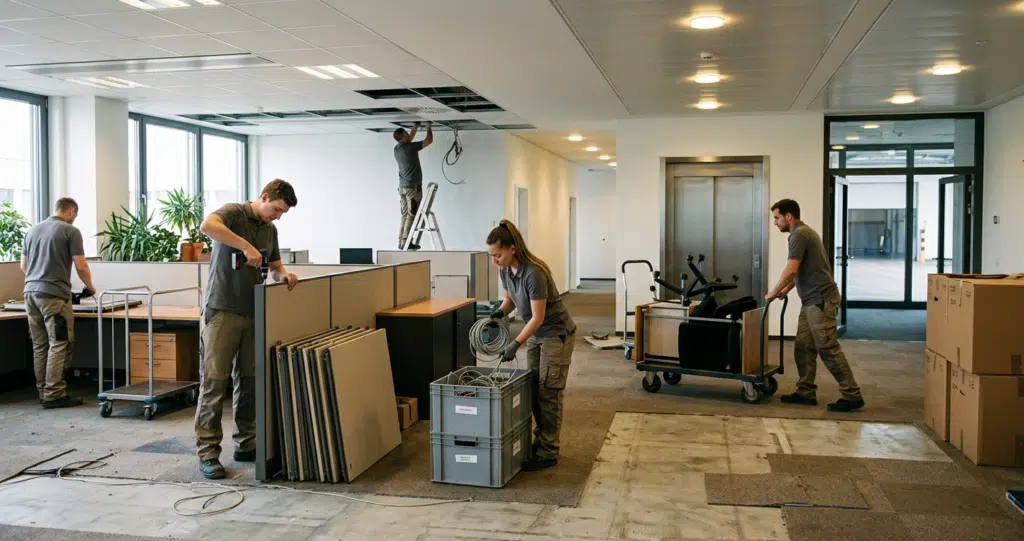
Decommissioning services help businesses prepare commercial spaces for their next use because organized equipment removal, furniture disposal, and facility restoration help makes the moving transition more efficient.
Whether your company is relocating, downsizing, closing an office, or renovating a facility, planning the departure properly can help prevent unnecessary complications.
Closing a commercial space involves more than moving desks and packing boxes. Businesses must consider lease requirements, technology, furniture, confidential information, building repairs, and coordination with property managers. Addressing these details early makes it easier to complete the transition while allowing employees to remain focused on normal business responsibilities.
What Does Commercial Decommissioning Involve?
Commercial decommissioning is the process of removing business assets and preparing a former workspace for its return to original lease standards. The exact requirements depend on the building, lease agreement, equipment, and condition of the property.
A typical project may involve removing desks, cubicles, conference tables, filing cabinets, and other furniture. It can also include dismantling workstations, removing unwanted equipment, addressing cabling, coordinating cleaning, and arranging repairs.
At The Quality Group, we help businesses manage office decommissioning as part of a larger relocation or facility transition. Our office decommissioning services include furniture breakdown, removal of unwanted items, recycling coordination, and planning assistance.
When Should a Business Plan for Decommissioning?
The best time to begin planning is before the actual move or facility closure. Waiting until the last few days can create scheduling conflicts, make it difficult to coordinate vendors, and leave important lease requirements unfinished.
Several situations commonly call for a decommissioning plan:
- Office relocation: A company moving to a new building must determine what happens to its existing furniture, equipment, and fixtures.
- Downsizing: Businesses reducing their office footprint may need to remove surplus workstations and storage systems.
- Lease expiration: Tenants may have specific responsibilities for restoring the property before returning possession.
- Business closure: Organizations shutting down operations must arrange for the removal and disposition of remaining assets.
- Facility renovation: Remodeling projects may require clearing furniture, equipment, and other materials before contractors begin work.
Starting early provides time to review the lease, establish priorities, and coordinate the people responsible for completing each task.
How to Organize Equipment, Furniture, and Technology
Before removing anything, create an inventory of the assets in the building. Separate items into categories such as equipment to relocate, furniture to store, items to donate, materials to recycle, and property designated for disposal.
This process helps prevent useful assets from being discarded accidentally. It also gives management a clearer understanding of what must be removed and how much coordination the project requires.
Technology deserves special attention. Computers, printers, telecommunications equipment, servers, and storage devices may contain confidential business or customer information. Coordinate with your IT team to determine which equipment will be relocated, which devices require data handling, and which items should be retired.
The Quality Group also provides vendor coordination for technology-related relocation activities. Our vendor coordination services help organize third-party providers, including IT support and equipment recycling resources.
Understanding Lease Requirements and Building Restoration
One of the most overlooked parts of leaving a commercial property is understanding the condition in which the landlord expects to receive it. Lease agreements may address furniture removal, wall repairs, flooring, cabling, signage, cleaning, and other restoration responsibilities.
Review these requirements before scheduling the work. If the agreement requires the removal of tenant-installed items or repairs to altered areas, those responsibilities should be included in the project schedule.
A walkthrough with the property manager can help identify areas that need attention. Photographs and written notes also provide a useful record of the property’s condition before and after the work.
Our project management team can help coordinate the different activities involved in a commercial transition. Having a designated point of contact makes communication easier when multiple teams and vendors are involved.
Furniture Removal, Reuse, and Responsible Disposal
Not every item in an office needs to be thrown away. Furniture and equipment that remain in usable condition may be suitable for relocation, storage, donation, or recycling.
Modular workstations, desks, chairs, conference tables, and filing systems may have value beyond the current location. Proper disassembly can also help preserve furniture that a business intends to use again.
The Quality Group provides office furniture installation and reconfiguration services, including furniture breakdown and setup. Our team can also help businesses coordinate the removal and disposition of unwanted furniture.
For technology assets, businesses should establish appropriate procedures for handling devices that contain sensitive information before recycling or disposal. Confirm that the selected service providers can meet your organization’s data-handling requirements.
Coordinating the Final Transition
A successful facility transition depends on scheduling the work in the correct order. Furniture removal, technology disconnection, cleaning, repairs, and final inspections may involve different providers, so responsibilities and completion dates should be established in advance.
Businesses relocating technology or specialized equipment may also need additional planning. The Quality Group offers data center relocation services for organizations that need assistance coordinating IT equipment moves in Louisiana and Mississippi.
Before handing over the property, review the lease requirements, confirm that scheduled work has been completed, and document the final condition of the space. Keeping records of completed tasks and vendor activities can make the handover process easier to manage.
Planning Decommissioning Services with The Quality Group
A well-organized transition helps businesses avoid last-minute confusion and prepare their former workspace for its next purpose. The Quality Group works with commercial clients throughout Louisiana and Mississippi, including Baton Rouge, New Orleans, Lafayette, and Jackson, to coordinate relocation and facility transition needs.
If your organization is preparing to close, relocate, or reorganize a commercial space, contact The Quality Group to discuss decommissioning services. Call 833-756-0103 or request a quote.
Frequently Asked Questions
What are commercial decommissioning services?
Commercial decommissioning services involve removing furniture, equipment, and other business assets while preparing a facility for its next use. Depending on the property and lease requirements, the work may also include cabling removal, cleaning, repairs, and vendor coordination.
When should a business begin planning a decommissioning project?
Businesses should begin planning as soon as they know they will be leaving or renovating a commercial space. Early preparation provides time to review lease requirements, inventory assets, schedule vendors, and organize removal activities.
What happens to furniture and equipment during decommissioning?
Furniture and equipment can be relocated, stored, donated, recycled, or disposed of depending on their condition and the business’s plans. Creating an inventory before removal helps ensure that useful assets are not discarded unintentionally.
Does office decommissioning include technology removal?
A project may include removing computers, printers, telecommunications equipment, and cabling. Businesses should coordinate with their IT personnel to address confidential information and determine how devices should be handled before removal or disposal.
Can decommissioning be coordinated with a commercial relocation?
Yes. Decommissioning can be planned alongside a commercial move so that furniture removal, equipment relocation, vendor scheduling, and preparation of the former property follow an organized timeline. Coordinating both activities can reduce the burden on internal employees and facilities managers.